
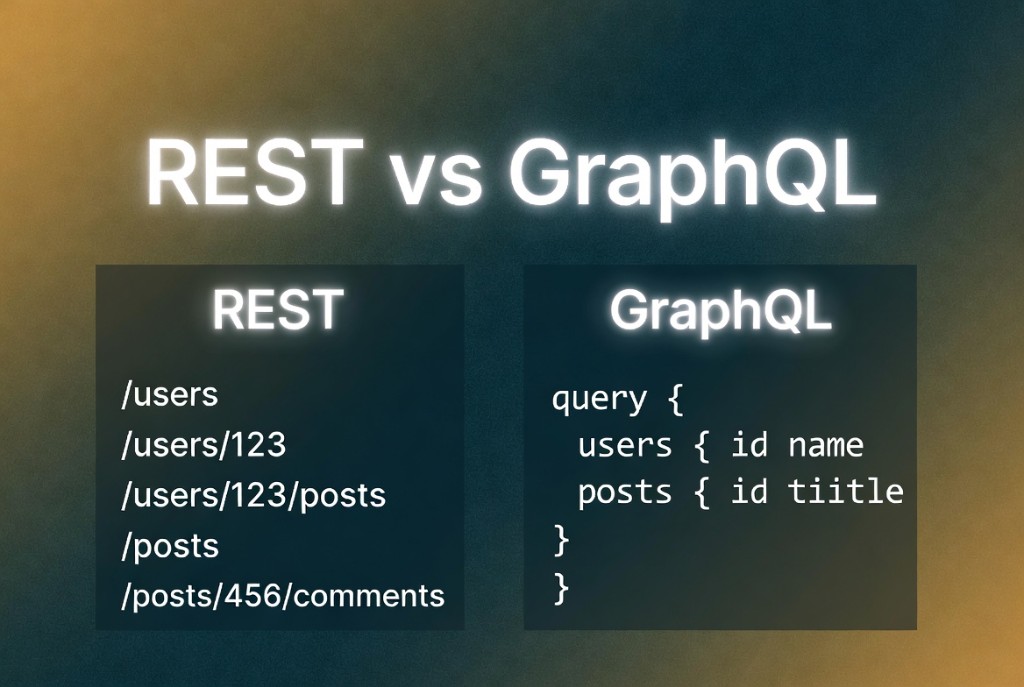
REST vs GraphQL for backend APIs
September 9, 2026 · 16 min read
REST maps URLs and HTTP verbs to resources; GraphQL exposes one endpoint where clients describe the shape they need. Neither is universally superior - teams argue about developer experience while production cares about latency, cache hit rates, and incident debuggability. This comparison focuses on backend trade-offs, not frontend fashion.
Resource model vs graph
REST encourages nouns (/users/1/orders) and standard methods. Versioning often lives in paths (/v2/) or headers. GraphQL schemas define types and resolvers; clients query a single POST /graphql with a document string. Backend teams own resolver performance and authorization per field, which is powerful and easy to get wrong.
Over-fetching and under-fetching
REST endpoints return fixed shapes - clients may download fields they never render. GraphQL lets clients request nested data in one round trip, but a naive resolver tree triggers N+1 database queries unless you batch with DataLoader or similar. REST fixes under-fetching with includes (?expand=orders) or hypermedia links; both styles need discipline.
query UserDashboard($id: ID!) {
  user(id: $id) {
    name
    orders(last: 5) { id total status }
  }
}
Operations and tooling
REST fits OpenAPI generators, HTTP caches, and familiar monitoring (status codes per route). GraphQL needs query complexity limits, persisted queries, and tracing per resolver. Debugging GraphQL often means logging the operation name and variables JSON; debugging REST means logging method, path, and response body hash.
Caching and CDNs
GET requests with cache headers are straightforward on REST. GraphQL POST requests are harder to cache at the edge unless you use GET for persisted queries or separate read models. Many BFF layers use GraphQL internally while exposing REST to partners for cache-friendly public APIs.
When to choose which
- Prefer REST when you need aggressive HTTP caching, simple public APIs, webhooks, and file uploads with standard semantics.
- Prefer GraphQL when many clients need different views of the same graph and you can invest in schema governance and performance tooling.
- Hybrid is common: REST for writes and events, GraphQL for complex reads behind your own gateway.
FAQ
- Is GraphQL a replacement for REST?
- It is an alternative for read-heavy, client-specific aggregation. Many organizations run both styles for different surfaces.
- Which is easier to secure?
- REST secures routes; GraphQL secures fields and resolvers. GraphQL requires explicit depth and cost limits to avoid abuse.
- How do I debug slow GraphQL queries?
- Enable resolver-level tracing, log operation name and variables, and look for N+1 patterns in database metrics.
Related: How to debug JSON APIs