
MongoDB binary subtype 4 explained
October 16, 2026 · 14 min read
In MongoDB, Binary subtype 4 (written 0x04 or UUID in Extended JSON) means “these sixteen bytes are a UUID in RFC 4122 byte order.” Drivers, Compass, and aggregation operators interpret subtype 4 consistently - unlike arbitrary Binary subtype 0 blobs or legacy subtype 3 GUID encoding.
What subtype 4 means
BSON Binary stores a subtype byte plus length plus payload. For UUIDs the payload is always 16 octets. Subtype 4 tells clients not to guess endianness: decode as RFC, render as canonical 8-4-4-4-12 lowercase hex with hyphens.
Greenfield applications should default to subtype 4. Subtype 3 remains for legacy .NET GUID compatibility - see the dedicated comparison article.
The 16-byte layout
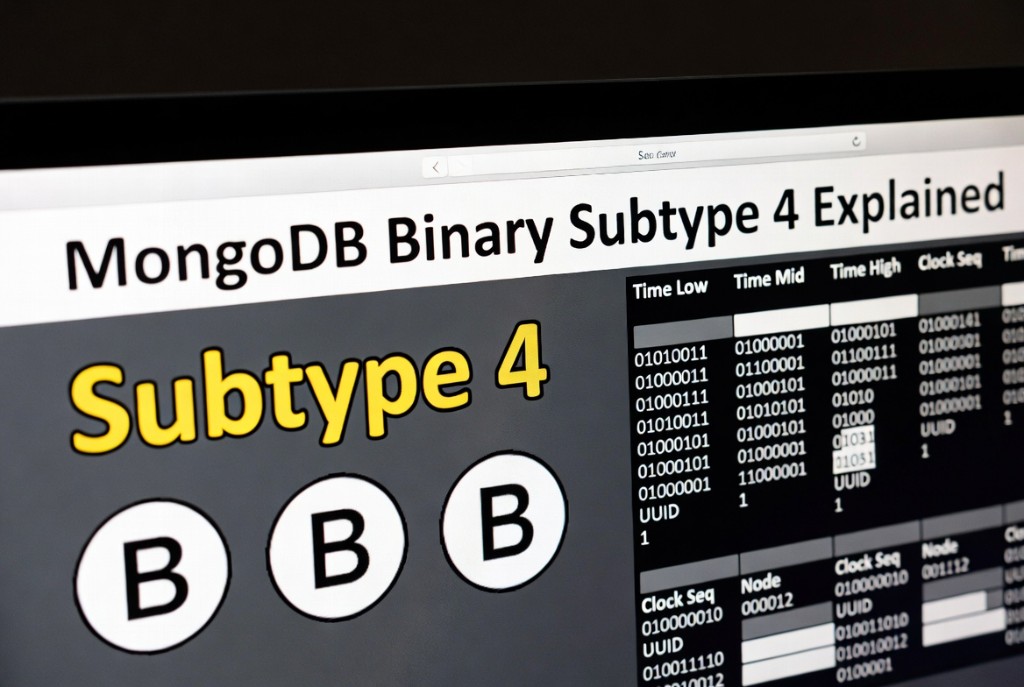
RFC 4122 splits 128 bits into five fields. In subtype 4 binary storage, those fields appear as contiguous bytes in standard order - no hyphens on disk. Version and variant bits live in time_hi_and_version and clock_seq_hi; validators use them to reject garbage lengths that happen to be 16 bytes.
Field names you will see in docs
- time_low - 4 bytes
- time_mid - 2 bytes
- time_hi_and_version - 2 bytes (includes version nibble)
- clock_seq - 2 bytes (includes variant bits)
- node - 6 bytes (often MAC-derived in v1, random in v4/v7)
Educational diagrams break the hex into these names so endianness swaps are visible - when the first twelve bytes permute but node bytes match, you are comparing subtype 3 vs 4, not different UUIDs.
// Extended JSON (canonical)
{ "_id": { "$binary": { "base64": "VQ6EAOKbQdSnFkRmVUQAAA==", "subType": "04" } } }

// Same logical ID as string:
// 550e8400-e29b-41d4-a716-446655440000
Subtype 4 vs string UUID columns
Strings waste index space and invite case/hyphen inconsistencies. Subtype 4 gives bytewise equality and smaller indexes. Tools export base64 in JSON; use a converter to human form for tickets.
How to read and write subtype 4
Node UUID class, Java UuidRepresentation.STANDARD, and Python BSON UUID types write subtype 4 by default on modern versions. Validate inbound strings, convert once, store binary. Use the MongoDB UUID converter and UUID validator when debugging exports.
FAQ
- Is subtype 4 the same as UUID string?
- Same 128-bit identity when byte order is RFC. String is human display; subtype 4 is storage.
- How many bytes on disk?
- 16-byte payload plus BSON overhead - far smaller than 36-char UTF-8 strings.
- Does v7 use subtype 4?
- Yes. v7 is still RFC layout; only version/time bits differ.
Related: MongoDB binary UUID explained · Subtype 03 vs 04 · Internal UUID storage